Day 6 - Eysturoy

We, our culture, and our language - our way of understanding and describing the world around us - are all products of place. We are intimately connected to the landscapes we move through, and the nature we inhabit. So just as the Sami people of northern Finland and Sweden, it is said, have over 20 different ways to describe snow in all its forms, the Faroese language has three different words for fog: mjørki, the dense, marine fog that lies in the valleys like a shroud (sarcastically called “Faroese sunshine” during the war by British sailors, who knew a thing or two about grey weather); skadda, the orographic nimbi that accumulate like cotton candy wrapped around the peaks of mountains; and pollamjørki, the thin ribbons of mist that lace the hillsides even on clear days, beautiful and beloved by islanders and visitors alike.

It is this lovely, latter type of velvet fog that clings to the valley walls when we awaken the next morning and peer out of the broad windows of our ground-floor apartment in Norðragøta. The mist is rolling in like a wave from the ocean to the south, while the first light of dawn begins to appear above the eastern ridge behind the house. After a breakfast of hard-boiled eggs, sliced ham, and orange cream yogurt with muesli, we get in the car and retrace our previous day’s drive along the fjords of Eysturoy. At the north end of Funningsfjørður, at a roadside overlook above the village of Funningur, we greet the sun as it appears over the shapely peaks of Kalsoy - tomorrow’s destination. We drive down into Funningur, where not a soul is stirring, and park beside the turf-roofed church at the water’s edge. Beside the church, a burbling stream flows past clumps of dandelions and flowering cat’s ears, and empties into the sound. Jane explores the village and finds a yard of domesticated ducks and geese, while I shoot a timelapse of sunrise framed by the church, the fjord, and the distant mountains.

An hour later, we return to the highway and take the steep mountain road that runs between Funningur and Gjógv, passing under the shadow of the Faroes’ tallest mountains. After hairpinning our way to the top of the mountain pass, we park at a dirt turnoff above the valley and set off on foot up the rockstrewn slope toward the summit of Middagsfjall (“Midday Peak”). The climb is relentlessly steep, and in between gasps for air, we shield our faces from the blasts of arctic wind reverberating down the mountainside. At the top of the ridge, we are rewarded with a stunning view along the length of Funningsfjørður and out to sea beyond Kalsoy and the other Northern Islands. Far below us, the villages of northern Eysturoy are dwarfed by the surrounding topography, and the fish cages at the mouth of the fjord appear like tiny bubbles on a pond surface. Jane climbs to the top of the rocky ridgeline before we retrace our steps, descending toward our car parked beneath the broad, hulking mass of Slættaratindur and the sleek, arrowhead summit of Gráfelli.

We proceed along the road to the village of Gjógv (“Gorge”), at the northern tip of the island. Above the village, we stop for photos; Jane takes pictures of me standing on the grassy hummock beside the road, while I frame some shots of the village outfield - a curling stream cutting through neatly sectioned sheep pastures, which are dotted with glacial debris. Continuing on, we park beside the large guesthouse on the outskirts of the village, and walk down along the village lane. We pass a house with a yard festooned with all manners of decorations: Greco-Roman sculptures, a garden gnome, a standing flamingo. A decorative beehive and a cluster of birdhouses. We pass by an elderly Faroese gentleman, wearing a tweed cap and a knit wool sweater, who is painting his picket fence one fence-post at a time; his wife waves good morning to us from the front porch. Weaving in and out of alleyways between the brightly colored houses, we follow the stream as it runs through the village to a rocky boat launch at the shore. Descending a long flight of steps, we come to the massive cleft in the hillside that gives the village its name. Here, water drips down the moss-covered rocks in little rivulets, and even on this calm, sunny morning, water is sloshing around in the gorge as if it were an agitated bathtub. As protected as it is from the open ocean, one imagines it must be terrifying to land at this dock in rough weather. Indeed, the graveyard behind the village church has a memorial by the famed Faroese sculptor Janus Kamban, of a woman and two children looking out to sea; its inscription bears the names of over forty sailors - nearly every able-bodied man in the village - who died in a single horrific night during a winter storm in the early 1900s.

After exploring the gorge, we walk back up the hill to our car, and drive back southward along Funningsfjørður. We stop briefly at the head of the fjord (at the docks of the village which bears its name) to photograph a roadside waterfall beneath the mountain Múlatindur. The towering peak makes quite an impression, but unfortunately the falls are quite dry and difficult to compose with, given the proximity of the road, with its street lamps and powerlines. We resolve to return here later, to photograph the boathouses at the head of the fjord in the evening light. Returning to the south, we stop to pump gas at the Effo petrol station in Skálabotn before returning home to make our lunch sandwiches and take a long afternoon nap.

In the evening, we drive back to Funningsfjørður at park at the large gravel turnoff near the boat docks. I set up an abortive timelapse of the waterfall (cut short by the shadow rising up the mountainside as the sun sets beneath the west side of the fjord) but eventually settle on a timelapse of the clouds moving in over the boats in the fjord. Jane, for her part, mostly sits in the passenger seat of the car, playing games on her phone. We end the day with the same beautiful wisps of oceanic mist that started it. As the light disappears, the mist develops into shades of lavender and azure blue as it rolls down the mountainside, settling like a blanket over the valley as it drifts toward sleep for the night.

Day 7 - The Northern Islands

To the east of Eysturoy are a cluster of six islands, arranged like parallel fingers running north-south amidst saltwater fjords. Their narrow landmass is lined by steep and magnificent ridges, while the villages sit in the bowls and troughs between mountain peaks, or in the rare coves and harbors that lie sheltered from the swell of the open Atlantic. These islands, the farthest from the capital and the most northeastern of the archipelago, are what the Faroese call the Northern Islands (Norðoy) - and even in this strange land, they seem to be a world unto themselves. Gone are the idyllic pastures and limnic valleys of Vágar, the rolling hillsides of Streymoy, or the broad highlands of Eysturoy. On these narrow isles, the topography is profound, and excepting the major port town of Klaksvík, the human settlements are small and seem to all but cling to steep cliff faces above the sea, on which their livelihoods utterly depend.

The Northern Islands are not as isolated as they were in olden times, when they could only be reached after a long journey by boat, or a series of overland and inter-island ferries from the capital. The highway now tunnels beneath the sound between Eysturoy and the neighboring island of Borðoy, such that we can leave our apartment in Norðragøta and be in Klaksvík within fifteen minutes; the Faroes’ two largest cities are just over an hour and a half apart by car. Jane and I sleep in until 7 AM (missing sunrise by three whole hours) so that we can spend the day away from home, exploring the two islands of Borðoy and Kalsoy.

After a short drive through the town of Leirvík, with its car dealership, pizza parlour, and bowling alley, we enter a 4-mile undersea tunnel, lined by a colorful light display, that delivers us to the hillside above Klaksvík. Klaksvík is the major population hub of the Northern Islands, and a center for fishing and commerce second only to the capital. It is situated in concentric rings overlooking a broad, semicircular bay on the north side of Borðoy: the port district in the middle, followed by downtown shops, markets, banks, and football stadium, which are then surrounded by apartment buildings and residential suburbs on the hillside terraces. These are all flanked by refineries, quarries, and packing houses on the city’s outskirts. Facing north from anywhere in Klaksvík, the seaward view is dominated by the mountain ridges of Kalsoy to the northwest, which bisects the sound and obscures all view of Eysturoy, and the mammoth peak of Suður á Nakki, which looms over the city as if it were a smouldering volcano on an tropical island in the Pacific Rim. We drive to the docks, where we are first in line for the morning ferry run to Kalsoy. At promptly 8:30 AM, the mail boat Sam takes us onboard along with half a dozen other cars, and we hang around the deck for the breezy, 15-minute ride across the water.

On the other side, we disembark at Syðradalur (“Southern Dale”), a tiny cluster of houses at the southeastern tip of Kalsoy. From here, a single-lane asphalt road winds along the eastern coast of Kalsoy, passing through four mountain tunnels and connecting the island’s four small settlements. The skies are brilliantly blue and warm, and our passage north is accompanied by a flock of arctic terns riding the ocean breeze, their distinct snow-white plumage and deep forked tails glimmering under the mid-morning sun. At the north end of the island, after the long mountain tunnel beneath the bowels of Nestindar, we reach a bowl-shaped valley overlooking craggy sea cliffs, on top of which the village of Trøllanes clings with its cluster of houses, two small farms, a smithy, a derelict church and one-room schoolhouse. The village, for all its remoteness, is one of the oldest continuously inhabited places in the Faroes - the farms are listed are far back as the 1500s in the islands’ landholding records, and the settlement itself probably dates back centuries farther. Its name (“Troll Peninsula”) derives from olden legends, which state that the valley was once haunted by trolls from the surrounding mountains, who would regularly descend into the village and terrorize the locals. One such night, the elderwoman of the village, being infirm and unable to flee, hid beneath her living room table as pandemonium unfolded around her. She prayed aloud for Christ the Savior to protect her, upon which the monsters abruptly dispersed and returned into the hills, never to be seen again.

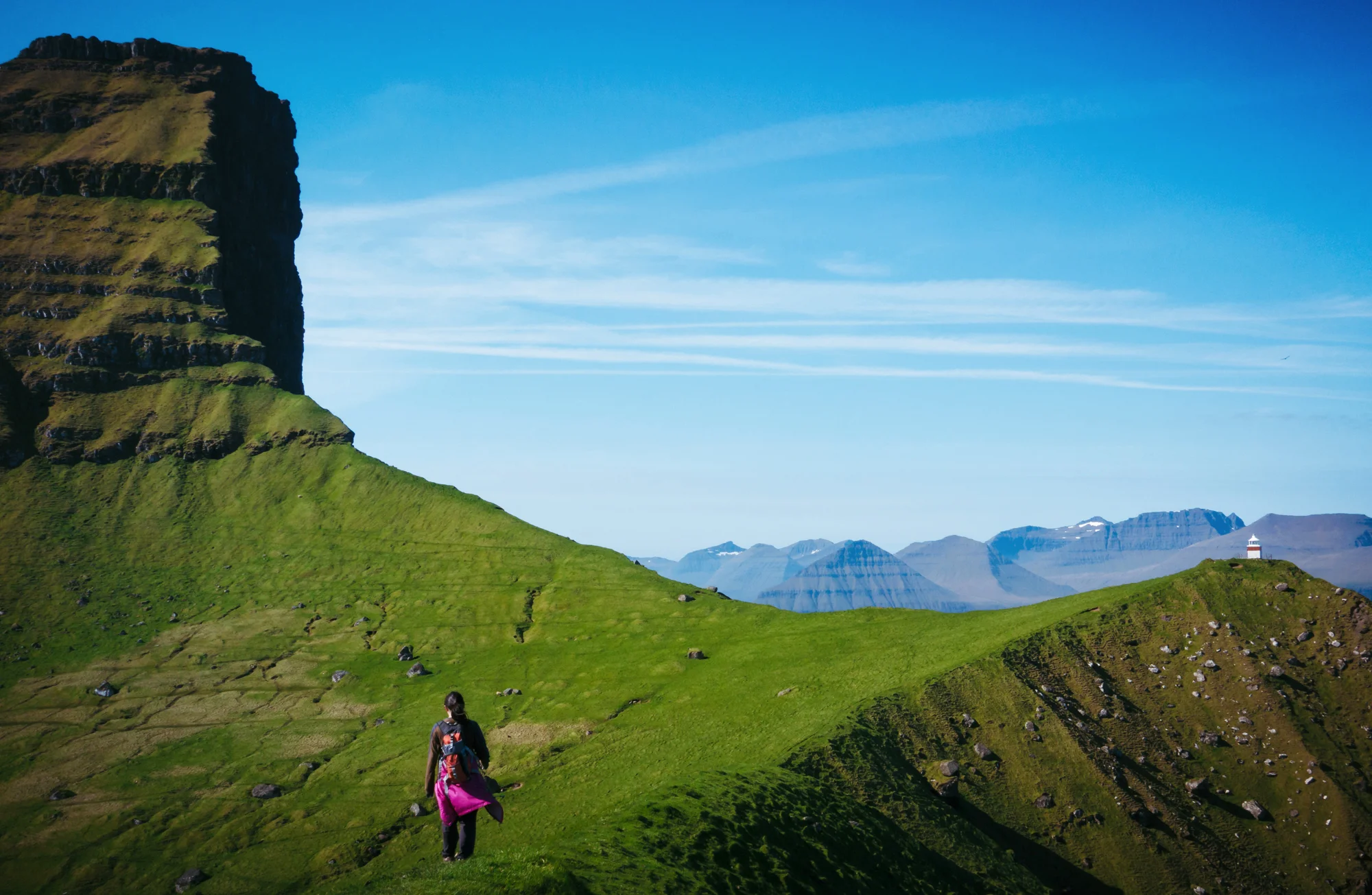
We park our car beside the small schoolhouse and trudge north, past a sheep gate and up a muddy embankment, onto a peninsula of steep green slopes - the land of the trolls. The rolling hillsides take us toward the lighthouse on the headland of Kallur, at the northern tip of Kalsoy. The walking path, which essentially follows sheep tracks, takes us past old stone foundations where shielings or shepherd's huts once stood, overlooking the ocean and the outlying islands looming like massive ships in the distance. On the way, we pass flocks of sheep sunning lazily in the dung-spotted grass, and the odd glacial erratic, much too large and too far downslope to have been cast down from the towering cliffs above us. At the end of the peninsula, we climb one last series of dirt steps up to the small beacon, which stands atop a triangular ridge that drops away to the sea in three directions. Beyond the lighthouse, Jane and I navigate a narrow dirt ridge that descends then climbs to the very tip of the island - again, not for the faint of heart. Here at the edge of land, we can see for miles around us - to the Northern Islands, to Eysturoy and the familiar figures of Risin and Kellingin, and to the north shore of Streymoy far beyond. After we pose for photos, I take pictures of Jane as she scrambles back to the lighthouse, her figure dwarfed by the precipitous seaward slopes and the titanic mountain face of Borgarin, which lords over the landscape.

After a short rest on the shoulder of the headland, we make the hour-long walk back to Trøllanes. We visit the schoolhouse turned community center for a bathroom break, then stroll into the village, following posted signs to the “Kiosk at the End of the World” - a little trailer shed selling snacks, drinks, frozen treats, and locally cured and dried lamb and lamb sausages. Upon our arrival, a woman from the house next door, busy gardening in only a bra and a pair of blue jeans, puts on a shirt and comes to tend to the cash register. “Hello!” she says cheerfully. “Beautiful weather today!” We say good morning and each pick out an ice cream bar from the freezer. Treats in hand, we sit at the top of the cliffs, above a series of stone steps leading down to a rocky landing, and watch as the surf pounds on the concrete below.

Back in the car, we return through the mountain tunnel, to the next valley to the south and the village of Mikladalur (“Great Dale”), the largest of Kalsoy’s four settlements. Before the road tunnel linked the two villages in the 1980s, a traveler between Trøllanes and Mikladalur would have to make the dangerous traverse over Nestindar - the island’s highest peak. The mountain trail would be all but impassable in the winter, and any inclement weather would roil the strait, making travel by boat a life-threatening affair at either of the villages’ cliffside landings. Such as it was, these neighboring villages spent centuries separated from one another through vast stretches of the year, their inhabitants eking out a lonely subsistence from the temperamental sea and the small pockets of arable land beneath the mountains. Today, a public bus runs up and down the length of the island several times a day, delivering commuters who ride the ferry to and from work in Klaksvík. Life has changed significantly here in the outer reaches of the Faroes - for the better, I suspect most of the Faroese would say.

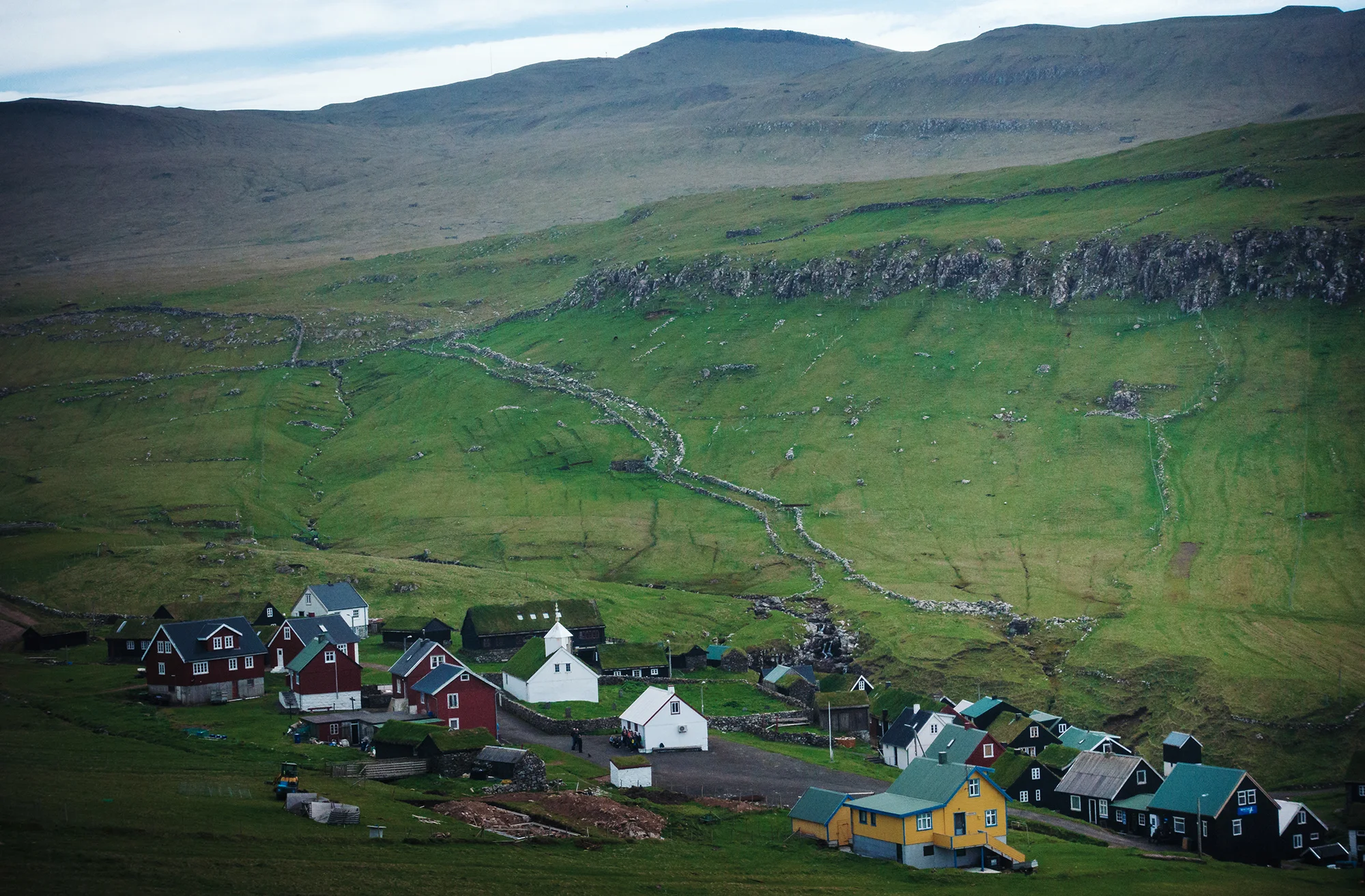
Mikladalur, too, is surrounded by several farms with outfields stretching to the foot of the mountains, including a small pine plantation (the first trees we have seen during the entire trip), which we drive past as we come down the hill into the valley. We park at a small turnoff just above the village and walk down among the turf-roofed houses, along narrow gravel lanes. We pass by several hjallur - ventilated wooden shacks, which function both for storing tools and for wind-curing lamb and mutton (skerpikjøt). Their door handles are fashioned from rams’ horns - an intriguing ornamental touch. Where the village houses meet the open ocean, a stream cascades over the edge of the cliff and into the ocean below. Beside the waterfall, we descend a series of stairs that lead to Mikladalur’s boat landing, little more than a battered basalt terrace exposed at low tide. There, on a prominent rock beside the sea, stands a bronze statue of the Kópakonan (“Seal Woman”), patina-stained after years of inundation by salt water. Many seagoing northern cultures, especially those of Scandinavia and the Atlantic isles, have tales about the sealfolk, mythological creatures capable of transforming from seal form into human form, said to be inhabited by the souls of drowned mariners. Perhaps it was the grey seal’s mournful, all-too-human bellowing at the water’s edge, or its long, silvery, hair-like fur, that was the inspiration for this shared body of folklore, which spans Scotland’s sylkies, Ireland’s merrows, Iceland’s marmennlar, and most famous of all, Denmark’s Little Mermaid. The Kópakonan is the Faroes’ analogue, and subject of one of the islands’ best known legends, which goes something like this:

In olden times, it was believed that seals were formerly humans who had died at sea - or perhaps voluntarily sought death in the vastness of the North Atlantic. Once a year, on the Twelfth Night, they were allowed to shed their sealskins and become human for a night, enabling them to leave the confines of the ocean, to frolic on land with reckless abandon. One year, a young farmer from the village of Mikladalur went down to the cliffside to watch the seals as they came ashore and danced on the rocks. There, he saw a beautiful woman with flowing dark hair, dancing with the other sealfolk beside the ocean. In an instant, he fell madly in love with this her, and knew that he must have her as his bride. Under cover of darkness, he crept down the rocks and stole her sealskin, hiding it away. At the end of the night, as sunrise began to light the rocky cliffs of Kalsoy, the other seals donned their skins and returned to the sea - but the woman could not find her skin, and thus could not complete the transformation. With no choice or recourse, she entered the village of Mikladalur, and was taken in by the young farmer, who she eventually married. They lived together for years and years, and had several children together. But no matter how much time passed, she would always find her thoughts returning to the sea - to memories of her native home, and to longing for her friends and family who dwelled in the watery depths.

All this time, the farmer kept the sealskin hidden in a chest beside the hearth, locked by a key that he kept on his person at all times. One day, the call for grindadráp (whale hunt) was raised off-shore, and a great commotion erupted in the village as every able-bodied man took to the boats to join the pursuit. In his haste, the farmer left the key at home. Realizing his mistake, he rowed with all his might back toward shore, sprinted up the stone steps to the village, and hurried back to his dwelling - but it was too late. The sealskin was gone, along with his wife. The rest of the house was nicely tidied, the children safely tucked in bed, and the hearthfire put out.

Some time later, the men of Mikladalur planned to make an expedition into one of the deep sea caverns along the island’s coast, to hunt the seals that lived there. The night before the hunt, the Kópakonan appeared before the young farmer in a dream, and pleaded with him not to kill the great bull seal residing in the depths of the cave, nor the two seal pups accompanying him, for those were her true husband and children. In a fit of selfishness, and with no love lost for his former wife, the farmer did not heed her message. He joined the other men the next morning, and they killed every seal that they could find in the cave. Upon returning home from a successful hunt, the men divided the spoils; the bull seal, and the flippers of the two young pups, went to the farmer himself. Later that evening, as the head of the large seal and the limbs of the small ones were stewing over the fire, there was a crash as the seal woman burst through the threshold in the form of a monstrous creature. Seeing her own flesh and blood stewing in the pot, she screamed out: “Here is  the head of my husband with his broad nostrils, the hand of Hárek, and the foot of Fredrik! Now there shall be revenge, revenge on the men of Mikladalur! Some will perish at sea, and others plummet from the mountaintops; and so many shall die that the dead shall link hands to encircle the shores of Kalsoy!”

After she pronounced this curse, she vanished with a peal of thunder and was never seen again. But ever since that day, and even to this day, they say that men from the village of Mikladalur have met unusual fates at sea, their boats capsized by rogue waves or sudden squalls that emerge even out of calm blue skies. And likewise, the village shepherds, even climbing under clear weather, have suffered terrible and mysterious falls from the high peaks as they tried to gather their flock. So it is that the vengeful spirit of the Kópakonan continues to haunt Mikladalur to the present day - her statue at the water’s edge a somber reminder to every villager: not yet enough have died to encircle the long isle of Kalsoy.

It’s the noon hour when we return to the car. We sit in the back seat, enjoying our packed lunches (homemade sandwiches, fruit, and milk boxes) and watching the powerful northern winds ripple across the turf roofs of the village houses. Afterward, we drive back to the ferry landing at Syðradalur and take a short nap while awaiting our ride back to Borðoy. We return to Klaksvík in the mid-afternoon. Leaving the car in a parking lot by the docks, we walk around the city center, finding mostly shops for pricey wool products and tourist memorabilia. For an early dinner, we stop in at the Café Fríða, a hip little establishment with a patio overlooking the water, where we order an iced green tea and a platter of “Faroese tapas” - including a variety of delectable seafood snacks and local lamb. The fish salad with trout roe (below) is my personal favorite; the sandwiches of sliced fish and small shrimps, ordered by other patrons, also look delicious.

After our meal, we climb back in the car and drive to the outskirts of town. Ascending the slopes that form the western rim above Klaksvík, we turn up the long gravel drive nicknamed Ástarbreytin (“Lovers’ Lane”), a steep road that leads toward the peak of Klakkur - evidently a popular place for romantic sunsets and first dates. Our tiny Kia struggles as it climbs the rocky, uneven gradient, but we soon make it to a dirt lot beside the flat alpine meadow and pond of Hálsur. With our heavy jackets on, we pass through the sheep gate and make the short, 1-mile climb to the summit. At the top of Klakkur, we are treated to a full panorama of the islands below - Eysturoy beyond the mountains to our west, Kalsoy and Kunoy to the northwest and northeast, and the bulk of Borðoy to our east. The winds at the summit are sharp and powerful. Banks of marine fog and mist go hurtling by, briefly obscuring all view of the terrifying and dizzying heights below us. Jane helps me set up a timelapse of the clouds encircling Suður á Nakki like a crown, using the strait as a leading line into the horizon. After a half hour atop the mountain, wind-blasted and chilled to the bone, we make our descent back to the car, with the summits of Halgafelli and Háfjall rising before us to the south. The sun is beginning its gradual downward arc as we drive down the mountain, and the mountains cast a growing shadow over the port town. We return to Eysturoy through the undersea tunnel, and spend the evening relaxing and preparing for our last day of travel in the Faroes.

Days 8 & 9 - Mykines & Trip's End

On our second-to-last full day in the Faroe Islands, we backtrack from our apartment in Norðragøta all the way to the docks of Sørvágur, and embark on a day trip to the westernmost island of the country. Mykines is a truly special place, an island for island lovers. Located a few miles offshore and a thirty-minute boat ride from Vágar, Mykines is like the fingertip of the archipelago, pointing westward into the vastness of the North Atlantic. Beyond its last rocky holm, upon which stands an old white lighthouse, there is no further land until one reaches the distant shores of Greenland, over a thousand miles away. It is, in some sense, quite literally the edge of the Old World.

One comes to Mykines for its bird life. The sea-facing cliffs of this remote island, eroded over time by wind and waves, are brimming with the nests of razorbills, guillemots, and gannets; the dark basalt faces are plastered in guano. Down by the water’s edge, black cormorants gather in great colonies on the rocky terraces that are exposed at low tide, and far above, on the island’s grassy slopes, hundreds of thousands of Atlantic puffins have made their home, undermining entire hillsides with their burrows. Other migrants - fulmars, shearwaters, and storm petrels - use the island as a space to rest and congregate amidst their long journeys throughout the North Atlantic. It is an incomparably wild and alive place, and this is immediately apparent the moment we enter the narrow cleft that passes for Mykines’ natural harbour, and are greeted by the screams of thousands of circling seabirds, whose wings all but blot out the sky.

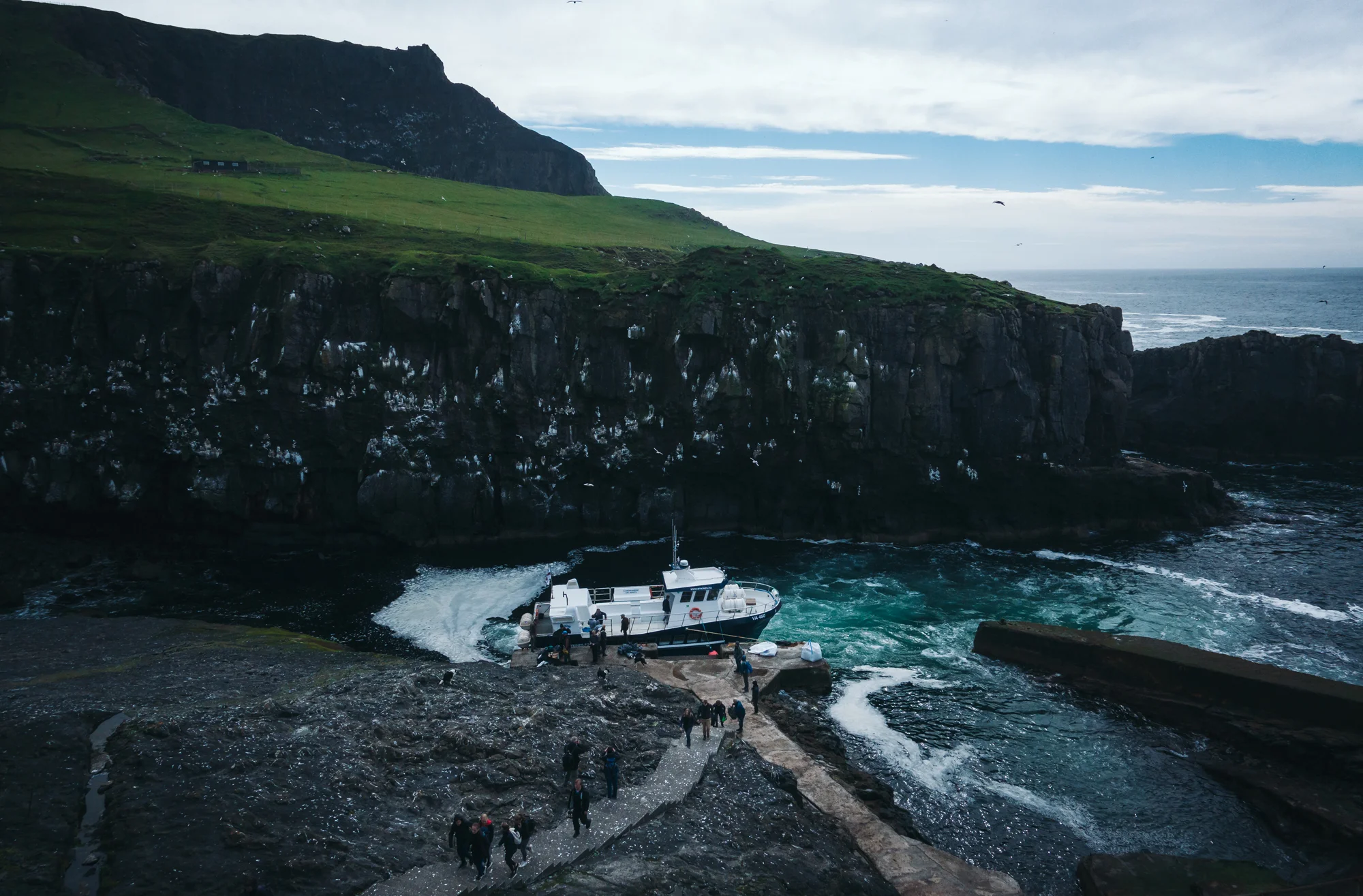
It is somewhat fortunate that we land on Mykines at all. As mentioned earlier, our original booking at the beginning of the trip was cancelled due to inopportune weather conditions. Although, at the time, we stood at the dock in Sørvágur and wondered what could possibly forestall a short boat ride under calm blue skies, this also becomes apparent as our little ferry boat, the Jósup, enters the rocky gap in the cliff. The tide forms a seiche that sloshes back and forth in the cleft, and the boat seems to rise and fall precipitously with every eddy. We virtually leap from the boat deck onto the concrete landing, accompanied by a host of other daytrippers, and a squad of middle schoolers on a class trip from Denmark. One gets the sense that one wrong gust of wind - or one disastrous wave - could easily dash the small boat into pieces against the cliff. As soon as it disgorges its human and non-human cargo, the Jósup quickly swings around and departs, eager to regain the safety of open water.

We proceed up a long flight of concrete steps cut into the cliffside, accompanied by the cries of the onlooking gulls and gannets. Two border collies that accompanied us on the boat ride, evidently excited to be back on home soil, go racing past us up the cliff and beyond to the village. Above the landing, we get our first look westward at the adjoining islet of Mykineshólmur, its distant lighthouse the goal of our day’s hike. From there, we enter the village of Mykines, a little settlement of forty houses arranged in concentric circles surrounding an island stream. Forty houses, many of which date back over two centuries - but these days, the permanent population has declined to ten or so individuals, who tend to the island’s farm, its sheep flocks, and its singular hostel and café. During the warm months, when the ferry runs twice a day (weather permitting) to Mykines, the village flourishes, and its summer homes are occupied by vacationers from Vágar and elsewhere in the archipelago. But during the other eight months of the year, the last few inhabitants of Mykines carry out lonely and isolated lives. The winter wind is cold and biting, and the swell of the waves makes the harbor inaccessible. The only way for food and supplies to be brought in - or medical emergencies to be brought out - is via helicopter. It is only a ten-minute flight across the ocean to the Vágar airstrip, but it might as well be an eternity away.

From the village, a grassy slope leads up to the western ridge of the island (other trails lead out of the village to the east, but the foreboding, mountainous eastern half of the island is inaccessible except by hiring a guide). As we climb the hillside above the village, we catch our first glimpse of the puffins, sunbathing on the grass, standing around awkwardly, and generally looking comical and bored. There is nothing especially attractive about these birds, except that they are uniquely clumsy and not particularly intelligent. The air is filled with puffins circling between the sea and the hills; we watch one puffin at a time as it swoops in, makes an attempt to land, but then aborts at the last second, apparently realizing in a moment of sheer panic that its trajectory - or maybe its entire purpose in life - are somehow off. The puffin does this over and over again - perhaps five or six times on average, by our count - until it finally musters up all its courage and talent, coming in for a crash landing while frantically flapping its fat white pectoral muscles in a vain braking maneuver. Inevitably, the bird is stunned for a moment, after which it lets out a self-assured hawww and continues about its business. All around us, we are surrounded by hawwws; the cumulative sound evokes a suburb full of lawnmowers on a Saturday morning - the sound of my childhood, transposed magically onto an isle in the middle of the Atlantic. Some birds return carrying small wriggling fish in their beaks, but most seem to come with nothing to show for all their effort. It is a testament to nature’s bounty that a bird so dumb can thrive in such a fashion. “If this hill weren’t all grass, they’d all be dead,” says Jane thoughtfully behind me. “Yes, but that’s the point,” I say.

To enter the puffins’ nesting ground, which lies on a sheltered hillside under the crest of the island, one must pay a small fee (in person or online), which goes to ensure that the trail to Mykineshólmur is adequately maintained, and that access to this sensitive area is tightly regulated. Beyond a small gate, where our prepaid tickets are checked by a hiking guide from the Faroese tourism board, we climb to the top of the island before turning and descending to the sanctuary via a stone staircase cut into the steep side of the cliff. As we enter the nesting grounds, the density of birds increases by an order of magnitude - all around us, flocks of puffins go flying by in loose formation, while the chainsaw hawwws can be heard emanating from every opening in the ground. It certainly seems that the entire hillside is honeycombed by puffin-created tunnels, and that one wrong step could put you foot-first in the burrow of a surprised puffin family. Eager not to disturb the birds, we stick closely to the walking path, which is marked by short yellow posts driven into the grass. Descending the steep hillside and another staircase, we come to an enclosed, chain-link bridge over the narrow gorge that separates Mykines from Mykineshólmur. In the olden days, there was only a rope straddling the sea, and the men of Mykines would have to brave the heights above the raging waves in order to reach the fertile bird-hunting grounds on the holm. Clinging to the slippery hillsides with bare hands, the fleyging (puffin-hunting) men would use long netted poles (fleygingarstong) to sweep unsuspecting puffins out of the air, mid-flight. Many men fell while doing so, or died scaling the cliffs to harvest the other sea birds and their eggs. What are now Faroese delicacies were once a dangerous, vital means of sustenance on this rugged edge of the sea.

On Mykineshólmur, the walk flattens out into a rolling seaside hillscape. We walk past a ram with its ewes, grazing contentedly on the grass in the salty breeze. Turning up a steep embankment at the end of the pasture, we reach the crest of the little islet and the old white lighthouse, which stands at the very tip of the land. Built in 1909, the lighthouse suffered a German air attack in 1941, and was thereafter repaired and became fully automated in 1970 - the year that the last lighthouse-keeper moved off the holm for good. It is now visited primarily by birdwatchers and summer hillwalkers, including the middle school class that has beaten us here. The atmosphere is festive, as people lie upon their jackets on the grass, unpacking picnic spreads brought from home or from the small café from the village. We sit for awhile, enjoying the sun and the fresh air, and watching the cormorants as they dive from the outlying sea stacks into the brilliantly blue waters of the Atlantic. On our way back to Mykines, we pass a memorial stone erected on the hillside to honor those who have died on Mykines over the centuries - shepherds, fowlers, and fishermen who gave their lives for the survival of their island community.

Back in the village, Jane and I are greeted by a swarm of schoolchildren carrying ice cream cones. Intrigued, we stop by the café, where we each buy a double scoop of strawberry and banana drizzled with chocolate syrup. We sit on a wooden bench in the cellar of the café, enjoying our desserts in solitude while awaiting our afternoon ferry ride back to Sørvágur.

Alas, the afternoon ferry never comes. We are informed by the café owner, who gets a telephone call from the captain of the Jósup, that a strong southeasterly wind is blowing, making the island’s boat landing too dangerous to access. Our return is pushed back from 4 PM to 10 PM, she announces to a chorus of groans from the tourists and patrons. Fortunately, Jane and I claim a table in the café, and set about making ourselves comfortable for the afternoon. Jane orders a cup of hot tea, and we share a bowl of fish stew - delicious, curried soup made with cod, carrots, celery, and potato, and served with a hot loaf of bread. We eat our dinner in silence as the atmosphere in the dining room turns positively brooding, the tourists sullen with the prospect of being marooned overnight on a remote island with - gasp - no internet access. My mind turns over the worst-case scenarios (big storm blows in, ferry can’t sail, we miss our flight to Copenhagen in 40 hours, we’re weeks late coming back to the States, I’m fired by my residency program, etc.).

After a few hours spent between worrying and dozing in the cramped café, I go out to catch a breath of fresh air. The Danish schoolchildren, nonplussed by the situation, are outside playing tag, flirting with classmates, or listening to music. I wander off on my own, walking down to the bank of the stream that runs through the settlement. The houses, with their bright facades and green turf roofs, are charming in the waning light. Using our binoculars, I watch as a pair of rams play-fight (or perhaps really fight) on a distant hillside, repeatedly backing up and charging their horns into one another until one gets tired and retreats. I walk down to the boat landing, above which a wind sock sits utterly still and limp on the cliffside, a hopeful sign for the stranded tourist.

Back in the café, Jane and I share another cup of tea (the poor lady’s inventory is practically bought out at this point) before the owner excitedly announces that the Jósup is sailing from Sørvágur. She asks us to gather our belongings and hurry down to the dock - the landing, if it happens, will be a brief one. We file out of her home, thanking her for hosting us all evening, while secretly hoping we won’t be back anytime soon. Down at the cliffs, we congregate on the steps above the landing. At length, the ferry boat appears around the bend and stops short of the harbor. We wait with bated breath for several tense minutes while the captain studies the dock, where massive waves are crashing over the concrete pilings. Finally, the boat engines hum to life, and the captain guns the boat forward at full speed, throwing her around 180 degrees so that she drifts barely against the dock, facing outward and ready to escape at a moment’s notice. The captain and his two sons appear on deck, urging us forward and pulling us onto the boat, two-by-two. In a few short minutes, the few dozen of us are seated onboard, and the boat comes alive again, quickly regaining open water. We wave back at the café owner and her family, who have come to see us off the island. One of the Danish schoolgirls, apparently traumatized by the forces of nature, is sobbing while a circle of friends try to console her. The sun sets behind Mykines as we sail away to the east, and soon we are surrounded by the familiar waters and villages of Vágar. At Sørvágur’s docks, a huddled mass of anxious parents awaits their stranded children. With no one waiting for us, Jane and I return to our car and make the long drive back to Eysturoy in the fading light, arriving home around midnight.

Our actual last full day in the Faroes is Thursday. After a weeklong marathon of early sunrises and late sunsets, we decide to sleep in and have a relaxed day.  My knees, weak and wobbly after two years of hospital life,  are battered from all of the elevation gain on our hikes, so we scratch our original plan of summiting Slættaratindur and opt instead for Jane’s preferred activity - shopping. In the late morning, after a breakfast of yogurt and cereal, we drive to Torshavn hoping to pick up something nice - or, as Jane puts it, “just have a look around.” We park at the harbor and spend the day walking around the city center, browsing craft stores, and wandering around the hilly neighborhood streets of the seaside town. Surprisingly, Jane abstains from any purchases while I walk away with a green argyle sweater from the local thrift store - for $10.  In the afternoon, we drive back toward Norðragøta, following the curving highway along the waterways and fjords of Streymoy and Eysturoy while blasting Faroese folk music on the radio. Along the way, we make a pit stop at the Bónus grocery store in Oyrarbakki, just after the bridge between the main islands, where we met our German hitchhiker friend a few days earlier.  At the Bónus, we pick up some food for a relaxed evening at home, including more fish cakes and chocolate and snack-packs of cheese dip for the road tomorrow, and a rather affordably priced jar of sturgeon caviar from Denmark. We spend the rest of the day packing, eating, and enjoying that lovely time in a vacation when there’s absolutely nowhere left to be and nothing left to do.

The next morning, while Jane sleeps in, I drive to the roadside overlook above Funningur, fifteen minutes away, to catch a final sunrise in the Faroes before we fly out at noon. I shoot a lovely timelapse - my favorite of the trip - of the sun rising over the mountains of Kalsoy across the water, paralleling the steep slope of Nestindar at it ascends into the eastern sky. Afterward, Jane and I have a last breakfast at the apartment,  clearing the fridge of the last of our sandwich stash. With the bags in the car, we drive back across Eysturoy and Streymoy and through the undersea tunnel to Vágar, a farewell tour retracing our journey through the islands. After a brief stop for fuel at the petrol station in Miðvágur, we return to the tiny two-gate airport beside Sørvágsvatn, where we began our trip.

The flight back to mainland Denmark is short and uneventful. From the airport, we take the light rail into the capital, where we will spend the night before flying back to Maryland. At Nyhavn, the historic waterfront in Copenhagen, we find our hostel tucked in an adjoining courtyard, and check into our private room on the second floor. Summer is in full swing in Copenhagen; having come from the Faroes, we are severely over-dressed for the blistering, 90-degree weather in the city; shedding our outerwear and hiking boots, we go outside in t-shirts and flip-flops. The dockside and the adjoining corridor of restaurants and cafés are packed with patrons and tourists, and folks are sitting shoulder-to-shoulder beside the canal, legs dangling over the water while watching the boats go by. We wander for a bit, sharing a cone of cookie dough ice cream from Vaffelbageren, and finally settling on an outdoor seafood dinner at one of the many identically non-descript, tourist-trappy restaurants by the water. Jane orders a salmon steak, while I have a split lobster (which is in season and served with roe and dill dressing). We share a plate of steamed mussels. For what it’s worth, the food is quite good.

After a quiet evening, we return to the airport in the morning and catch our noon flight back to Dulles, our return trip significantly less delayed and less eventful than our outbound one. We’re back in Baltimore by late afternoon, with a long day of travel and jetlag behind us.