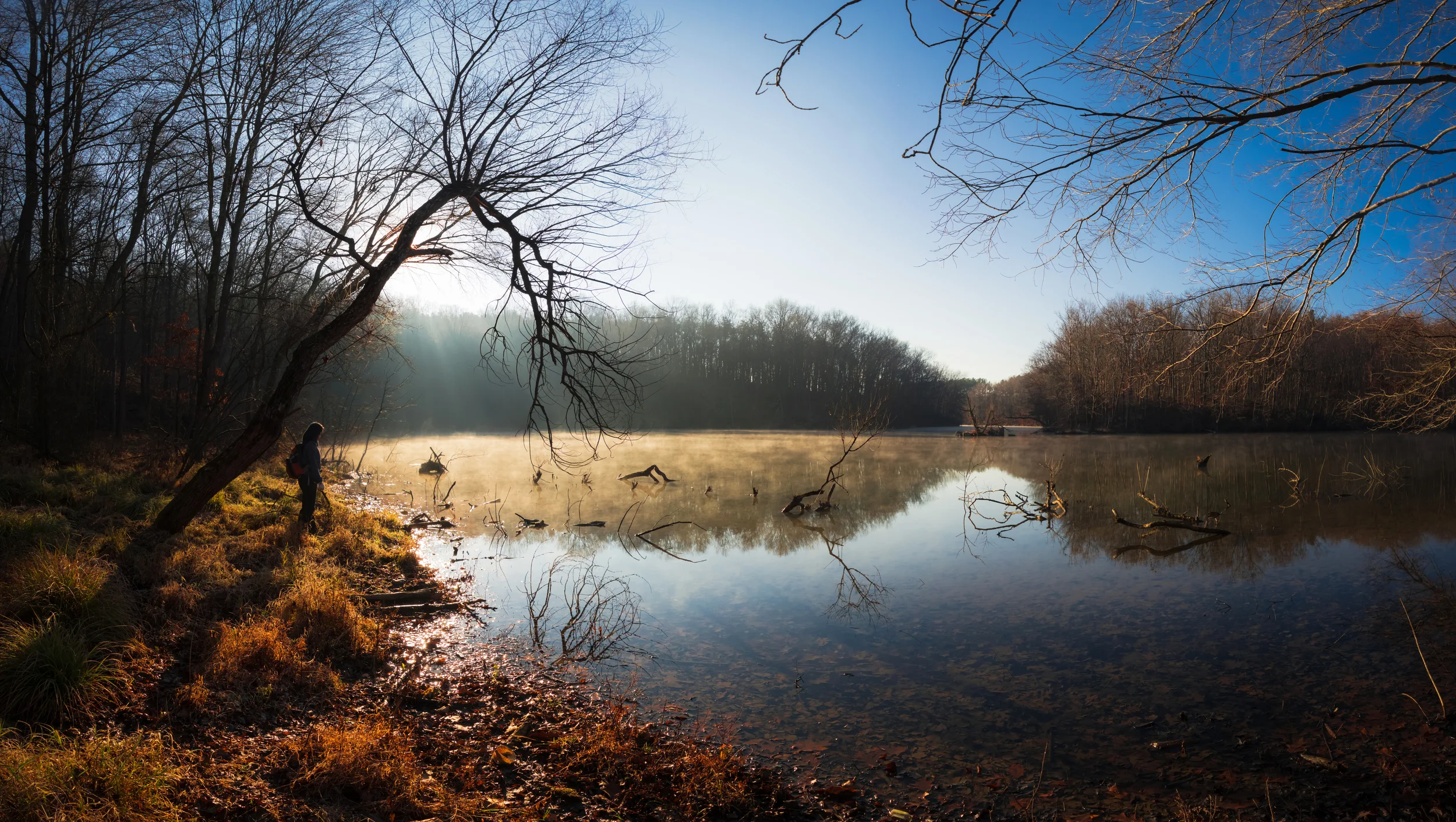
Liberty Reservoir: Before the Thaw

Jane is out of town this weekend, which is an excellent excuse to catch sunrise by myself in the woods. Waking at 5 AM, I drove northwest to Liberty Reservoir, to a pull-off along Deer Park Road which, over a year ago now, I first mistook for the trailhead to Piney Point. Piney Point or not, this little spit of earth over the lake remains my favorite place in the woodlands of Baltimore County.

I arrived a minute after sunrise and quickly made my way down to the shore for this photo. The center of the lake was hosting a flock of several hundred honking Canada geese; the edges were not quite thawed. On my way back, I stopped at the bridge on Deer Park Road, where an elderly fisherman was setting up his bait and tackle. "Damn lucky there's a hole out the middle 'ere," he told me with a chuckle as we looked over the railing. "Aye, good morn for ice fish'n out 'ere."

I was home and back in bed at 8 AM.

Baltimore: Shoulder Season

Here in the Mid-Atlantic, "shoulder season" is what I think of as the time between Thanksgiving and Christmas, when the weather is cold but not quite cold enough, the leaves are gone but the ground not covered in snow, and occasionally, the late, soft sunrises are joined by the warm, still air of an Indian summer (is there such thing as Indian autumn?). For me, this month is what makes Maryland so special. It is obviously not "shoulder season" in New Haven or in hardly any other region of the country.

These photos were taken on two hikes we did on consecutive December weekends - in the Hilton area of the Patapsco Valley (20 minutes to our west), and at Liberty Reservoir (30 minutes to our northwest). Waking leisurely at 7 AM on Saturday, hitting the trailheads closer to 8 AM, and delighting in the low, slow arc of the winter sun and its gentle golden light. A never-ending sunrise. Tinted morning mist drifting up over water and wood.

Susquehanna: Mother River of the Chesapeake

45 minutes to our northeast is the Susquehanna River, which forms the border between Maryland and Delaware. One of the great rivers of this region, the Susquehanna is the longest river on America's Atlantic coast. Its branches drain from the mountains of upstate New York and western Pennsylvania, forming a mighty waterway that flows through Pennsylvania and Maryland to the head of the Chesapeake; it was the ancient Susquehanna River Valley that became the Chesapeake Bay when the ice caps melted and the ocean invaded, separating mainland Maryland from the Delmarva Peninsula ten thousand years ago.

On the southern (Maryland) bank of the river estuary is the Susquehanna State Park, with its network of excellent forest and riverside trails. We have hiked here before, most recently last Thanksgiving. We come here to not only admire the river, but to pay tribute to living history - two mighty trees (an American Beech and a White Oak) that date back to the American Revolution and may have been among the progenitors of their kind on the Atlantic seaboard.

On a cool October morning, the week before our Maine trip (thus marking the last Mid-Atlantic hike of our 2015 fall season), Jane and I drove up the I-95 and parked at the old water mill beside the river. We watched the sunrise color the treetops, the rocky riverbanks, and the placid river below. We walked northwest along an abandoned railroad paralleling the river, then along a footpath. A few motorboats hummed from the distant shore, carrying fishermen we couldn't quite see. Turning away from the river, the trail leads us down a wide fire road and past an old flint tower - also from the days of the Revolutionary War.  Beyond the tower and across a two-lane road bridge, we turn onto a uphill path that leads into the forests south of the river.

Autumn is present in the air, and there is some gold in the canopies, but most of what greets the eyes is still green and lush. This is how mid-October looks in the Mid-Atlantic. We rarely see the brilliant flames of autumn that characterize this time in New England, but we gain in duration what we sacrifice in intensity. Fall comes more gradually here. If you neglect to hit the trail one weekend, the woods will still be where you left them. If you forget the next, then you may be left wondering what happened. Jane and I will be away next weekend, so we are trying not to make that mistake. We climb up the hillside overlooking the river, following the green trail blazes as they curve, almost hidden, through the woods. The treetops are still thick with leaves so that the sunbeams seem to reach us photon by photon, in brilliant flashes of gold light. We've only hiked here before in the late fall and winter, so both of us are quite astounded at how little we recognize the place, how little we can see through the trees.

Which is why we are both struck speechless when we round the corner and see a familiar friend. Jane walks ahead and I take the photo below; the grandfather of American Beech trees, sending its ancient branches up over a hundred feet, like Atlas holding up an absolute amphitheatre of forest canopy. We commune; walk up, touch its bark, gaze upward without any intention or hope of seeing the top. Then we move on through the forest to the south and west. We take a side trail to see the White Oak - equally tall and terribly beautiful - before returning eastward along a farm trail which takes us through a series of hay meadows.  After 8 miles of walking, we return to the car and set off back toward Baltimore around noon on a Saturday. There is usually traffic.