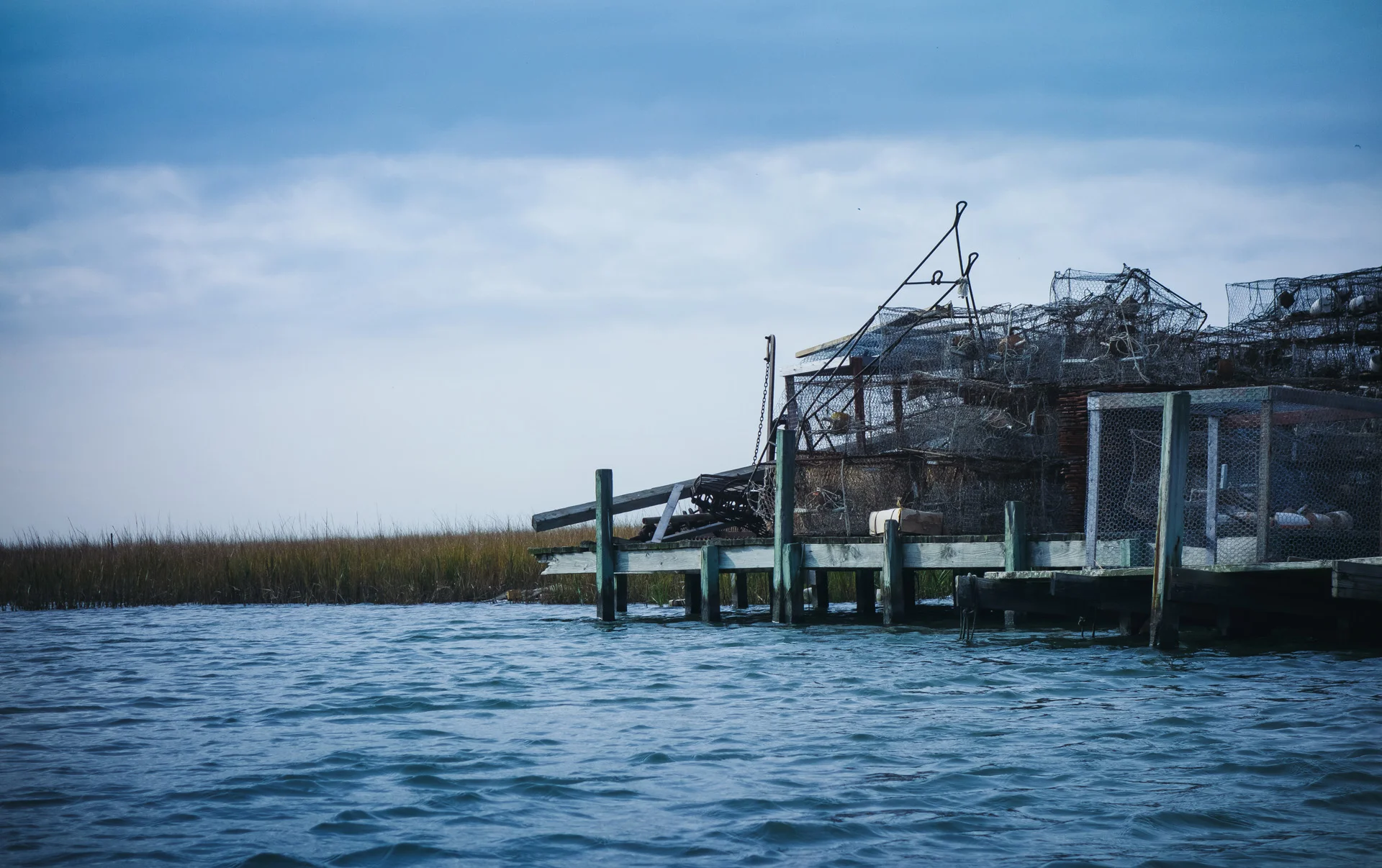
The sun is beginning to sink toward the horizon as we ride back through the marsh toward Ewell. I stop by the roadside to frame a few sunset shots, using the marsh guts as leading lines into the endless expanse of Spartina (salt grass). Even in the mid-autumn, the wetland mosquitoes are out in full force, a veritable flight squadron of them lunging greedily for my face and hands as I try to create composites with the tripod (it's hard to blot out lens flare with your fingers when arthropods are trying to eat them!). We beat a hasty retreat into town and back to Susan's; before heading indoors, I pause to photograph the sunset colors developing in the clouds over the bay. Lovely view, indeed.
In the house, Susan steps out of the kitchen to greet us warmly. We head upstairs to clean up while she prepares dinner; the smell of grilled seafood emanating throughout the house is inebriating. Coming back down the steps, we sit for awhile on the covered porch, watching the marsh birds and the sunset through our binoculars. Susan starts us off with dinner rolls and butter, followed by our plates of mashed potatoes, grilled asparagus, and homemade crab cakes - massive mounds with great, gleaming lumps of meat, pan-seared to perfection. Jane and I agree instantly (and we are no strangers to the culinary delights of Baltimore or the Eastern Shore) that it is the best crab cake we have ever eaten. For dessert, we are treated to Maryland's official state dessert, the classic Smith Island cake - a dozen ultra-thin layers, alternating between gleaming, moist, velvet-like cake, and decadent chocolate frosting. Later in the trip, we are treated to a variety of Smith Island cakes and flavors and such as vanilla, pineapple, and peanut butter, but for Jane and me, Susan's rendition (which she prepared for former Governor O'Malley at a banquet years prior) is unbeatable. It is a watershed moment for us.
After dinner, Susan sits and chats with us for a bit about Smith Island and its history. Her family, the Evanses, had no small part in this history, as they go back thirteen generations to the island's earliest colonists in the late 1600s. The population of the island, which was never large, peaked at under a thousand people in the early 20th century, when tourism was booming, American towns were growing, and the Bay and its watersheds were relatively clean and bountiful. Today, there are roughly 200 full-time inhabitants (and falling) and the population is aging. Most households are still lead by watermen, whose lives and livelihoods are inextricably bound to their boats, the seasons, and the struggling health of the Bay. Increasingly, though, there are more families like Susan's, whose occupations and trades are tied closely to the mainland; or mainland snowbirds who own property on the island, and bring their families here to vacation in temperate months, but never truly integrate into the web of island society. The children, what few of them there are, commute to school on the morning ferry, and almost invariably leave in adulthood for wider horizons. The dreary winter months, when the watermen in their workboats are away oystering for weeks at a time, and the entire Bay becomes locked with ice, can be profoundly isolating for the remaining islanders. And the Chesapeake Bay, still in the throes of its ten-thousand-year birth from the Susquehanna River Valley of the last ice age, accelerated more than ever by rising sea levels from anthropogenic climate change, continues to mount a steady assault on the land. Every year, several acres of the island are washed into the Bay; by the end of this century, Rhodes Point and most of Ewell will no longer exist - if its inhabitants haven't long since fled from the coming onslaught of Atlantic hurricanes and tidal flooding. Smith Island's way of life - in one sense, the oldest, most American way of all - is slowly but surely disappearing into the sea.
Heartbreaking as it is, Jane and I are just glad to spend two evenings here, to have been born early enough to explore the island and meet its community, if only briefly. Susan leaves us with tea, snacks, and the entire house to ourselves (she is staying with her father, she explains, whose health has recently deteriorated). Before she leaves, she sets out the tandem kayak and paddling gear, and gives us a map of the island's waterways for our adventures the next day. We lounge around in the living room, watching the better part of a Harry Potter movie while sipping on tea, before retiring for the night.